OPEN: MON - FRI 8AM - 5PM
Check our current lead time for Cut & Edge orders COLLECTIONS: 8AM - 4PM
Which Should You Choose?
Veneered MDF has a thin layer of real wood bonded to medium-density fibreboard (MDF), while solid timber is wood throughout its thickness. Veneered MDF is often practical for broad furniture panels; solid timber gives more scope for shaped edges and repeated refinishing. The better choice depends on how each component will be used.
Published: 21st September 2026
For a fitted wardrobe, bookcase or table, the visible wood is only part of that decision. You also need to consider movement, exposed edges, support, finished weight and how the surface could be repaired later.
Choosing these details before cutting helps you avoid a panel that looks right but needs an edge treatment, fixing method or finish you have not allowed for.
Explore Cworkshop’s veneered MDF range to compare materials for your furniture panels.
Solid timber and solid wood describe the same basic construction here: timber through the component, rather than a decorative wood layer over an MDF core. A wide solid timber top may consist of several boards joined edge to edge.
The face of a veneered panel is also real wood, with its own grain and colour variation. It differs from a printed wood-effect surface. Cutting through the panel, however, exposes the MDF beneath the veneer.
| Consideration | Veneered MDF | Solid timber |
|---|---|---|
| Appearance | Natural veneer that can be selected and arranged for a coordinated grain pattern | Natural grain through the thickness; appearance depends on board selection |
| Stability | Generally more stable across broad panels, but still sensitive to moisture and construction | Expands and contracts, particularly across the grain |
| Repair | Light preparation is possible; deep damage can break through the veneer | Usually offers more scope for sanding and refinishing |
| Edges | Cut edges expose MDF and need planned treatment | Timber edges can be shaped directly |
| Cost | Often economical for broad hardwood-faced panels; include edging and finishing | Species, grade, preparation and joining affect the final cost |
| Weight | Depends on core density and panel dimensions | Depends on timber species, moisture content and dimensions |
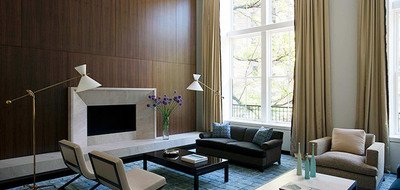
Walnut veneered MDF provides a darker alternative, but the final appearance still depends on the veneer selection and finish.
Veneered MDF can help create a coordinated appearance across doors, drawer fronts and cabinet sides when the veneer is selected and arranged accordingly. Solid timber also has natural grain, with the finished appearance controlled by the boards you choose and how they are joined.
Neither material is automatically uniform or knot-free. Veneer can show natural variation, while selected solid timber can have a restrained, consistent appearance. Check the actual grade and sample rather than judging from the material name alone.
Oak veneered MDF can suit light-toned shelving, cabinet fronts and fitted furniture. Walnut veneered MDF provides a darker alternative, but the final appearance still depends on the veneer selection and finish.
Decide which way the grain should run before arranging the cutting list. Turning a door front through 90 degrees to use an offcut may save material while leaving its grain visibly different from the neighbouring doors.
If you want the grain to continue across a row of drawer fronts, discuss the required layout before cutting. Specifying the same wood species alone does not guarantee a continuous pattern.
Check the reverse face too. A panel with a decorative face and a different backing veneer may be suitable for a cabinet side, but less suitable where both sides remain visible. With solid timber, board selection and the arrangement of joints need similar attention.
Veneered MDF generally offers greater dimensional stability than solid timber across broad interior panels, provided the core and panel construction suit the conditions. It can still swell or bow, so greater stability should not be confused with immunity to moisture.
Solid timber changes size as its moisture content changes, with much more movement across the grain than along it. Species and grain orientation affect the amount.
For a solid timber table top, the fixings must accommodate that movement. Rigidly restraining the top across its width can contribute to splitting or joint failure. Choose table-top fixings that let the top move across its grain relative to the base.
For veneered MDF, check the core grade, balanced panel construction and the supplier’s conditioning instructions. MEDITE’s distinguishes dry-use MDF from moisture-resistant grades and calls for balanced construction when applying veneers or laminates.
Moisture-resistant MDF is not waterproof. Protect edges and cut-outs, particularly near sinks and appliances, and avoid standing water. A surface coating cannot compensate for an unsuitable core or continual wetting.
Edge treatment should be chosen before the panel dimensions are finalised. On veneered MDF, every visible cut edge needs a deliberate finish if you want the wood appearance to continue around the component.
Wood veneer edging can cover a straight MDF edge. Solid timber lipping, a strip attached to the panel edge, provides more timber to work with where a suitable profile or more substantial edge is required.
These choices affect the finished size. If lipping is added after cutting, the panel and lipping together must produce the required overall dimension. Confirm whether the cutting list records the finished edged size or the underlying panel size before ordering.
Routing a deep round-over directly into veneered MDF will expose the core. Choose an edge construction that accommodates the intended shape, and make sure any lipping is wide and deep enough for the profile.
Solid timber gives you more freedom to shape the edge directly. A rounded table edge or moulded rail can be cut into the timber without revealing a different core, although grain direction still affects machining.
For straight exposed edges, Cworkshop’s panel edgebanding service offers wood edging options. Specify which edges will be visible after assembly.
Shelf performance depends on thickness, span, load and support, rather than the appearance of the face. A thin oak veneer does not give an MDF shelf the properties of a solid oak board.
Start with the contents the shelf will carry and the distance between supports. A shelf holding a few display pieces presents a different problem from a long shelf filled with books.
For either material, check the actual product or timber properties and adjust the design where needed. A central division, shorter span or properly designed reinforcement may be more useful than changing the visible wood species.
Fixings also need to suit the material beneath the surface. Screws entering an MDF edge require particular care with pilot holes, spacing and the selected fixing system. Follow the board and hardware manufacturers’ guidance rather than assuming a fixing that works in solid timber will behave identically in MDF.
For doors, check the finished panel weight and hinge requirements before drilling. Larger or thicker panels may need a different hinge arrangement, even where their external appearance is unchanged.
Solid timber usually offers more scope for repairing deep scratches and dents because there is wood beneath the damaged surface. Veneered MDF can also give long service in well-supported, properly finished indoor furniture, but repairs are limited by the thickness of its wood face.
Neither material has a guaranteed lifespan. Moisture exposure, joints, support, edge protection and everyday treatment all affect how well the furniture lasts. The finish matters too: a coating scratch is a different problem from damage through the wood itself.
Veneered MDF can be lightly sanded where the veneer and finish instructions permit it. Heavy sanding to remove a deep mark can expose the core, especially near corners and edges. Damage through the veneer may need a patch or replacement surface rather than further sanding.
Solid timber can often be sanded and refinished several times, but the depth of damage, joints, profiles and remaining thickness set the limits. This is useful for a table top expected to receive regular wear, provided the construction also allows for timber movement.
For either material, test the chosen finish on a matching offcut. Clear oils and lacquers can change the colour and sheen. Our guide to finishing oak veneered MDF explains preparation, edge treatment and coating selection in more detail.
Veneered MDF can reduce the cost of producing broad hardwood-faced panels, particularly when the alternative involves preparing and joining several solid boards. The saving depends on the species, grade, layout and work required.
Compare the cost of finished components, including:
The material needed after allowing for waste and grain direction.
Cutting, joining and machining.
Edging or solid timber lipping.
Surface preparation and finishing.
The likely maintenance and repair needs.
A veneered cabinet side with one exposed edge is a different cost proposition from a heavily shaped top requiring substantial timber lipping. Equally, a small solid timber component may be economical when it can be made from a suitable board without extensive preparation.
Veneered MDF is not automatically lighter than solid timber. Compare components at the same dimensions and use the supplier’s weight or density information; the result depends on the MDF grade and timber species.
For a tall wardrobe door, check the finished weight before choosing hinges. For a large top, plan how it will be carried into the room and lifted onto its supports. Increasing thickness can change both the handling and hardware requirements.
Choose the material for each component rather than assuming the whole project must use one option. A broad side panel has a different job from a leg, frame or exposed table edge.
Two oak surfaces may look similar while needing different edge treatments and fixings. Check the core, reverse face and exposed edges before committing to the material.
Adding lipping to a panel already cut to its final size can make the finished component too large. Set the edge construction before confirming dimensions.
Choosing hinges or planning a lift on that assumption can leave the hardware or handling arrangements unsuitable. Check the actual finished component weight.
Deep sanding can remove the decorative face. Assess marks before preparation and test the finish on an offcut instead of experimenting on a visible door front.
A less decorative reverse can become obvious on an open shelf or freestanding divider. Specify the appearance needed on every visible face.
Ordering veneered MDF cut to size allows rectangular sides, shelves and fronts to be prepared from your cutting list. Settle the construction first so the dimensions account for adjoining panels, hardware clearances and edge treatment.
Include the material, thickness, quantity and dimensions for each component. Add grain direction, visible-face requirements and the edges to be finished. Where drilling or other machining is needed, provide the positions and details required for that work.
Leave room in the plan for site-specific fitting. Fillers against uneven walls may still need scribing, and accurate panel cutting cannot correct an unsuitable support arrangement or an incorrect opening measurement.
Cworkshop supplies veneered boards with cutting and panel edgebanding services, so the material and exposed edges can be specified together.
Where the design requires shaped panels, holes or grooves, CNC cutting can be included in the preparation. Confirm the machining requirements before placing the order.
For a factory-applied finish, Cworkshop also offers clear lacquering in matt or satin. The spray service applies to panels cut by Cworkshop; only edgebanded edges are sprayed, with raw edges left unfinished. Include that distinction when planning any later site cuts.
Veneered MDF and solid timber can both produce attractive, useful furniture. The choice depends on the component: its visible faces, exposed edges, supports, environment and likely repair needs.
Choose the construction before finalising the cutting list. That gives you a clear basis for specifying panels, edging and finishing, whether the project uses veneer, solid timber or a combination of both.
Browse Cworkshop’s veneered boards to choose the material for your next project.