OPEN: MON - FRI 8AM - 5PM
Check our current lead time for Cut & Edge orders COLLECTIONS: 8AM - 4PM
Which Core Should You Choose?
Published: 9th September 2026
Start with the finish.
Choose MDF when the surface or the edge is going to be seen, shaped or painted. Choose melamine faced chipboard (MFC) for pre-finished panels, especially cabinet interiors and carcasses where cost, weight and speed matter.
That single distinction resolves most projects. The rest of this guide covers the cases where it does not.
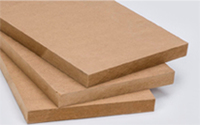
MDF is medium density fibreboard. Wood is broken down to individual fibres, mixed with resin and pressed into a panel with no grain, no voids and a uniform core. The surface is smooth enough to paint directly and the core is consistent enough to machine into.
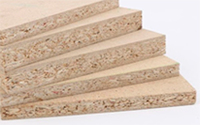
Chipboard, also called particleboard, uses wood chips and flakes rather than fibres. The chips are larger, the core is coarser, and the board is built in layers with finer particles at the faces and coarser ones in the middle. That structure makes it lighter and cheaper, but it also means the exposed core looks like what it is.
That last point drives almost everything else. Chipboard is rarely sold or used raw for furniture. It is sold faced, most commonly as melamine faced chipboard, where a decorative melamine layer of around 0.3mm is bonded to each side. When people compare MDF against chipboard for a kitchen or a wardrobe, they are almost always comparing painted MDF against MFC.
The comparison at a glance.
| Property | MDF | Chipboard and MFC |
|---|---|---|
| Core structure | Wood fibres, uniform throughout | Wood chips, coarser core, finer faces |
| Weight | Heavier | Lighter |
| Cost | Higher | Lower |
| Surface as supplied | Raw, ready to prime and paint | Usually pre-finished in melamine |
| Takes paint directly | Yes | No, the melamine face is not a paint substrate |
| Can be moulded or profiled | Yes | No |
| Edge quality when cut | Clean and dense, can be sealed and painted | Coarse, needs edging tape |
| Screw holding in the face | Good | Good |
| Screw holding in the edge | Moderate, pilot holes needed | Poor, needs the right fixings |
| Stiffness over a span | Better | Weaker, sags sooner |
| Finishing work required | Priming, painting or spraying | None, it arrives finished |
| Recycled content | Lower | Often high |
| European standard | EN 622-5 | EN 312 |
Where MDF works best.
MDF’s smooth, uniform surface makes it well suited to painting. It takes primer and topcoat far better than any faced board. If your finish is a colour rather than a decor, MDF is the default.
Anything shaped. MDF machines cleanly in all directions, which means it can be routed, profiled, moulded, V-grooved and CNC cut with a crisp edge. Shaker doors, fluted panels, moulded skirting and any CNC machined part come out of MDF. Chipboard cannot do this. Route into a chipboard edge and you expose a coarse, crumbly core that no amount of filler rescues.
Exposed edges without banding. An MDF edge can be sealed, filled and painted so it disappears. A chipboard edge cannot, and always needs covering.
Long spans and shelving. MDF is stiffer per unit of thickness, so it sags less over an unsupported run. Neither material is genuinely good over a long span, but chipboard gives up first.
Anywhere fire or emission performance is specified. MDF is available in flame retardant and zero added formaldehyde versions, covered in the MDF grades guide.
Where chipboard works best.
Chipboard is generally cheaper as a raw board, while MFC also saves finishing time and cost because its surface is already finished. A painted MDF carcass carries the cost of the board plus priming, painting or spraying, plus the time. An MFC carcass carries the cost of the board.
Weight. Chipboard is lighter than MDF of the same thickness. On a full kitchen or a run of wardrobes, that difference is felt on every panel you lift, and it is the reason flat-pack furniture is built from it.
Speed. MFC arrives finished. Cut it, edge it, assemble it, done. No priming stage, no drying time, no dust, no second visit to finish site work.
Surface durability. A melamine face is harder and more scratch resistant than most paint finishes, and it wipes clean. For the inside of a kitchen carcass or a wardrobe, that is a real advantage over painted MDF, which marks.
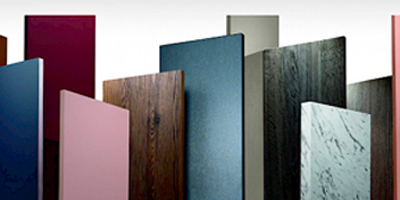
Decor choice. This is the one people underestimate. MFC comes in hundreds of woodgrains, stones, solid colours and textures across the Egger, Kronospan, Xylo Surfaces and Alvic ranges. Reproducing a textured oak in paint is not an option.
Recycled content. Chipboard uses wood chips and can be made largely or entirely from recovered wood, which gives it a better recycled content story than MDF.
Choosing the right board grade.
Both materials have European classification systems, and both work the same way: dry versus humid conditions, load-bearing versus not.
Chipboard is classified under EN 312, from P1 to P7:
| Type | Use |
|---|---|
| P1 | General purpose, dry conditions |
| P2 | Interior fitments including furniture, dry conditions |
| P3 | Non load-bearing, humid conditions |
| P4 | Load-bearing, dry conditions |
| P5 | Load-bearing, humid conditions |
| P6 | Heavy duty load-bearing, dry conditions |
| P7 | Heavy duty load-bearing, humid conditions |
For furniture and cabinetry you are looking at P2, or P3 where humidity is a factor. P4 upward are construction boards for floors, walls and roofing rather than anything you would build a wardrobe from.
MDF uses EN 622-5, with equivalent logic and its own type codes. The MDF grades guide covers that system in full.
The useful takeaway is that "humid conditions" means the same thing in both standards, and in neither case does it mean waterproof. It covers occasional high humidity, not wet exposure.
Protecting your boards from moisture.
Neither standard MDF nor chipboard is waterproof. Both can swell and lose performance when moisture reaches the core, so moisture-resistant grades and properly sealed edges are important in kitchens, bathrooms and utility rooms.
Moisture resistant versions exist for both, and for a kitchen, bathroom or utility you should be specifying one. But the failure mode differs in a way worth knowing.
MDF swells at the edges and the swelling is visible as a soft, thickened lip. Because the core is uniform, damage tends to stay reasonably local.
Chipboard swells through the core, and once a chipboard panel has taken water it loses structural integrity rather than just looking bad. This is why a water-damaged kitchen carcass is usually replaced rather than repaired.
The mitigation for MFC is edging. A melamine face is effectively impervious, so water gets in through unsealed edges and drilled holes, not through the face. Edging with PUR glue rather than EVA gives a considerably more water-resistant joint, which matters most on sink cabinets and any panel meeting a floor. This is covered in the edgebanding service.
For MDF the mitigation is sealing every cut edge properly before it ever sees moisture.
Getting the fixings right.
Both materials hold screws well in the face and poorly in the edge, but chipboard is worse.
The reason is structural. Chipboard's coarse core has less material bonded around a screw thread, so an edge-driven screw into chipboard can strip or split the panel. MDF's uniform fibre core grips better, though it will still split if you drive into an edge without a pilot hole.
For reliable cabinet assembly, use fittings designed for panel products, such as cam-and-dowel fittings or confirmat screws, and follow the manufacturer’s drilling guidance. If you are building carcasses from either material, use fittings designed for panel products rather than ordinary screws, and pilot every edge fixing.
MFC has one extra consideration: the melamine face chips if you drill or cut without the right tooling. Scoring blades, sharp bits and correct feed rates matter more with MFC than with MDF.
MDF vs Chipboard
The right board depends on the finish, the application and the demands of the project. Use these questions to narrow down your choice.
Is the surface being painted? Choose MDF. Its smooth, uniform surface is well suited to priming and painting.
Do you want a woodgrain, stone or textured decor? Choose MFC. It arrives with a decorative finish already applied, saving the time and cost of finishing.
Will the part be shaped, routed or profiled? Choose MDF. Its uniform core makes it suitable for decorative machining and detailed profiles.
Is the part hidden inside a cabinet? MFC is usually the practical choice. It provides a durable, wipe-clean surface without the need for painting.
Is it a long shelf or unsupported span? Consider the board thickness, expected load and additional support. Both materials can sag, so neither should be chosen on material alone.
Is weight or budget the main constraint? MFC is often the more practical option, particularly when the cost of finishing is included.
Do you need a fire-rated or low-emission board? Choose a product with the required certified grade or specification. Check the individual board rather than relying on the material name alone.
For most fitted furniture, a combination of both materials works well: MFC for carcasses and MDF for painted or shaped fronts. Each material is used where its properties offer the greatest benefit.
A cleaner cut, ready to use.
Both materials are awkward in full sheets and both cut far better on industrial machinery than on site.
MDF is heavy, and the MDF sheet sizes guide has the weights by thickness. MFC is lighter but less forgiving, because a chipped melamine face on a visible panel is a scrapped part rather than something you sand out.
For MFC, cutting quality is the whole game. Melamine chips on the exit side of a cut unless the saw is set up for it, which means scoring blades, sharp tooling and blades changed frequently enough to stay sharp. It is the main practical reason people who own a decent circular saw still send MFC out to be cut.
You can order MDF cut to size and MFC cut to size to the same cutting list, with edging applied to the parts that need it, CNC work where parts are shaped or drilled, and spray finishing on the MDF components. For a project using both materials, that means one order rather than three.