OPEN: MON - FRI 8AM - 5PM
Check our current lead time for Cut & Edge orders COLLECTIONS: 8AM - 4PM
A UK Buyer's Guide
Published: 4th September 2026
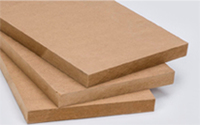
MDF sheets.
MDF is sold in a small number of standard sheet sizes, and which one you start from affects how much board you buy, how much you waste, how you get it home and whether your parts can be cut at all.
In the UK, MDF comes in two standard lengths and two standard widths. The lengths are 2440mm and 3050mm. The widths are 1220mm and 1525mm. Almost every sheet of MDF you will be offered is one of the four combinations those make:
| Sheet size | Imperial equivalent | Area |
|---|---|---|
| 2440 × 1220mm | 8ft × 4ft | 2.98m² |
| 2440 × 1525mm | 8ft × 5ft | 3.72m² |
| 3050 × 1220mm | 10ft × 4ft | 3.72m² |
| 3050 × 1525mm | 10ft × 5ft | 4.65m² |
2440 x 1220mm is the default. If someone refers to a sheet of MDF without specifying, that's what they mean.
The eight-by-four standard.
The size is a metric conversion of 8ft x 4ft, which became the standard for manufactured board long before the UK went metric. 2440mm is 8ft to within a millimetre, and 1220mm is 4ft.
The convention stuck because it is built into everything downstream: van and trailer beds, merchant racking, panel saw beds, CNC bed sizes and standard kitchen carcass dimensions. It is also about the largest sheet two people can realistically handle without machinery.
You will hear it called eight-by-four, 8x4, or a standard sheet. All the same thing.
3050 x 1220mm (10ft x 4ft) is the one to reach for when you need length. A full-height wardrobe side, a tall bookcase gable, or a run of wall panelling that would otherwise need joining are all cases where a 2440mm sheet simply cannot give you a single part longer than 2440mm.
This matters more than people expect. A standard UK ceiling height is around 2400mm, which sounds like a 2440mm sheet covers it. Once you account for the saw kerf, a squaring cut, and a floor or ceiling that is not level, you are often short. Older properties with taller ceilings put you well past what a 2440 sheet can do.
1525mm width (5ft) is less commonly stocked but useful when your parts are wide rather than long: deep shelving, wide worktops, tall doors cut across the sheet, or panelling laid horizontally. It is also worth considering when your cutting plan is wasteful on a 1220 sheet, because an extra 305mm of width sometimes lets you fit a whole additional part per sheet.
The catch is that oversized sheets are not stocked as widely, and the thickness range available in them is narrower.
Understanding sheet sizes.
This is where most planning goes wrong. A thickness that exists in 2440 x 1220 will not necessarily exist in the larger sheets. The oversized sheets carry a reduced range, and it varies by MDF type.
Here is how that plays out across a real UK stock range, taken from our MDF collection:
| Sheet size | Thicknesses stocked |
|---|---|
| 2440 × 1220mm | 3, 4, 6, 9, 12, 15, 18, 22, 25, 30, 36mm |
| 2440 × 1525mm | 6, 12, 18, 25mm |
| 3050 × 1220mm | 3, 4, 6, 9, 12, 15, 18, 22, 25, 30mm |
| 3050 × 1525mm | 12, 15, 18, 25mm |
Eleven thicknesses on a standard sheet. Four on the largest. That is the pattern to internalise: the bigger the sheet, the fewer thicknesses you can have it in. Note also that 36mm exists at 2440 x 1220 but not at 3050, because the very thick standard boards are eight-by-four only.
Moisture resistant MDF.
MR MDF is the exception that breaks the rule. The MEDITE MR range carries the full 6mm to 36mm spread in both 2440 x 1220 and 3050 x 1220. Finsa Hidrofugo covers the same at standard size, and 9mm to 36mm at 3050 with no 6mm option.
So if you need a long part for a bathroom, kitchen or utility, you have more freedom in MR than you do in standard MDF. Neither is stocked in 1525mm width.
A primed MR board is available too, in 18mm at 2440 x 1220 only.
Flame retardant MDF.
6, 9, 12, 15, 18 and 25mm at 2440 x 1220, but 25mm drops out at 3050. A 25mm fire-rated part longer than 2440mm is not something you can buy off the shelf.
Exterior MDF grades.
The most restricted of the lot. Exterior MDF is stocked at 18 and 25mm in the standard sheet, and only 18mm at 3050 x 1220. Tricoya Extreme runs 6mm to 18mm at standard size and, again, only 18mm at 3050.
If you are planning an exterior job around a long part in anything other than 18mm, check availability before you finalise the design rather than after.
Very thick MDF.
Above 36mm you move to a different product. Iberpan covers 36, 38, 40, 45 and 50mm at 2440 x 1220, and 36, 38 and 50mm at 3050 x 1220. These are worktop and structural thicknesses rather than general-purpose sheet.
The pre-finished boards follow their own size logic entirely:
| Board | Sheet size | Thicknesses |
|---|---|---|
| Kronospan White Smooth MDF | 2440 × 1220mm | 6, 12, 15, 18, 25, 30, 36mm |
| Kronospan White Smooth MDF | 3050 × 1220mm | 18, 36mm |
| Kronospan Black Textured MDF | 3050 × 1220mm | 18, 36mm |
| Finsa One-Side White Painted MDF | 2440 × 1220mm | 3mm |
| Finsa Fibracolour Black MDF | 2440 × 1220mm | 18mm |
| MEDITE Clear MDF | 2440 × 1220mm | 12, 18mm |
Note that the Kronospan black textured boards come in the 3050 length only, which is the reverse of the usual pattern.
3mm and 4mm.
Thin MDF has its own quirk. 3mm and 4mm are stocked in 2440 x 1220 and 3050 x 1220, but not in 1525mm widths.
That is usually fine, because thin MDF is mostly used for cabinet backs, drawer bottoms and templates, which are parts cut down small. But if you were planning a single unbroken 3mm panel wider than 1220mm, you cannot have one.
MDF specification.
Weight matters more than most people plan for. It determines whether you can lift a sheet alone, what vehicle you need, and how you handle it once it arrives.
MDF density is not constant. Thinner boards are denser than thicker ones, because the compressed face layers make up a larger proportion of a thin board. Standard MDF runs from roughly 840 kg/m³ at 3mm down to around 680 kg/m³ at 30mm and above.
Approximate weights, based on typical standard MDF densities:
| Thickness | kg per m² | 2440 × 1220 | 2440 × 1525 | 3050 × 1220 | 3050 × 1525 |
|---|---|---|---|---|---|
| 3mm | 2.5 | 8kg | 9kg | 9kg | 12kg |
| 4mm | 3.2 | 9kg | 12kg | 12kg | 15kg |
| 6mm | 4.7 | 14kg | 17kg | 17kg | 22kg |
| 9mm | 6.8 | 20kg | 25kg | 25kg | 32kg |
| 12mm | 8.9 | 26kg | 33kg | 33kg | 41kg |
| 15mm | 10.9 | 33kg | 41kg | 41kg | 51kg |
| 18mm | 13.0 | 39kg | 48kg | 48kg | 60kg |
| 22mm | 15.6 | 46kg | 58kg | 58kg | 73kg |
| 25mm | 17.5 | 52kg | 65kg | 65kg | 81kg |
| 30mm | 20.6 | 61kg | 76kg | 76kg | 96kg |
| 36mm | 24.3 | 72kg | 90kg | 90kg | 113kg |
| 50mm | 33.0 | 98kg | 123kg | 123kg | 153kg |
These are nominal figures. Moisture resistant and flame retardant boards run a few percent heavier than standard because of the resin systems used, and real density varies by batch and moisture content.
The practical line to remember is this. HSE guidance puts a sensible one-person lift at around 25kg, and less when the load is awkward or repeated. A sheet of MDF is about as awkward as a load gets. That makes anything from 12mm upward in a standard sheet a two-person job, and the larger sheets a two-person job from 9mm.
A 3050 x 1525 sheet of 36mm MDF is over 110kg. That is mechanical handling, not people.
Comparing MDF sizes.
Sheet dimensions are nominal. Under BS EN 324-1, the tolerance on length and width is around ±3mm, and squareness under BS EN 324-2 is permitted up to 2mm per metre. Across a 1220mm width, that means a sheet can legitimately be out of square by more than 2mm and still be within spec.
Never plan a cutting list that uses the full nominal dimension. If you need a part at exactly 2440mm you cannot reliably get it from a 2440mm sheet, because the sheet may be fractionally under, the factory edge may not be square, and squaring it takes material off regardless. Allow a squaring cut on your two reference edges and treat your usable dimension as smaller than nominal. If a part needs to be close to full sheet length, order the next size up.
Thickness is nominal too. Sanded MDF is typically held to ±0.2mm on thinner boards and ±0.3mm on thicker ones. That sounds trivial until you are cutting housings or rebates sized for exactly 18.0mm. An 18mm board can arrive at 17.8mm or 18.3mm and both are within spec, so measure the actual board before machining any joint that depends on its thickness.
Density is allowed to vary within a single board too, by up to around 10% from the mean. That is why the same board can rout beautifully in one area and fluff slightly in another.
One more spec is worth knowing. MDF leaves the factory at roughly 7% moisture content, and it moves with the humidity of the room it ends up in. Manufacturers recommend conditioning boards in their final environment for two to three days before cutting and fixing. Skipping that is a common cause of parts that fitted perfectly on Saturday and do not on Monday.
Board is priced by area, so a larger sheet costs more in absolute terms but not necessarily more per square metre. The real question is waste.
A 3050 x 1220 sheet gives you about 25% more area than a 2440 x 1220. If your parts nest efficiently on it, that is cheaper per usable part. If they do not, and you needed one long part while the rest goes to offcut, the standard sheet was the better buy.
Two things are worth doing before you order.
Lay your parts out before choosing a size. Sketch your cutting plan against each candidate sheet and count how many you would need. It is common to find the larger sheet drops your total sheet count, and equally common to find it does not.
Use the grain-free advantage. MDF has no grain direction, so parts can be rotated freely when nesting, which is a genuine advantage over plywood or veneered board. An awkward parts list often fits a standard sheet after all.
Look again at the weight table. A full sheet will not fit in most cars, needs somewhere flat and dry to store, needs a straight-edge and a decent saw to break down accurately, and produces a lot of fine dust.
This is why most people ordering more than a sheet or two have their boards cut to size rather than buying whole sheets. You supply the finished part dimensions, the board is broken down on a panel saw, and what arrives is the parts you need rather than the raw material. It removes the storage problem, the transport problem and the accuracy problem in one go. Because the cutting plan is optimised across the whole sheet, it usually reduces waste too.
The relevant point for sheet sizing is that if you are ordering cut to size, you do not need to pick a sheet size at all. Give the parts list and the most efficient sheet gets selected for you. Sheet size is only your decision when you are buying whole boards.
Where it still matters is the maximum part dimension. No cutting service can give you a part longer than the longest sheet stocked in your chosen board and thickness, which brings you back to the tables above.
Cut parts can also be edgebanded, CNC machined for shaped or drilled work, or spray finished before they reach you.